 Our Editorial Team




What Is Buying Gold for an IRA?
Buying gold for an IRA means purchasing IRS-approved physical gold inside a self-directed individual retirement account (SDIRA). When you buy gold for an IRA, you must select coins or bars that meet the IRS 99.5% purity threshold, purchase them through an approved dealer, and direct the custodian to ship them to an IRS-approved depository — you cannot take personal possession while metals remain in the IRA. The process combines the tax advantages of a traditional or Roth IRA with the inflation-hedging and diversification benefits of physical gold ownership.
Should I Invest in Gold in My IRA?
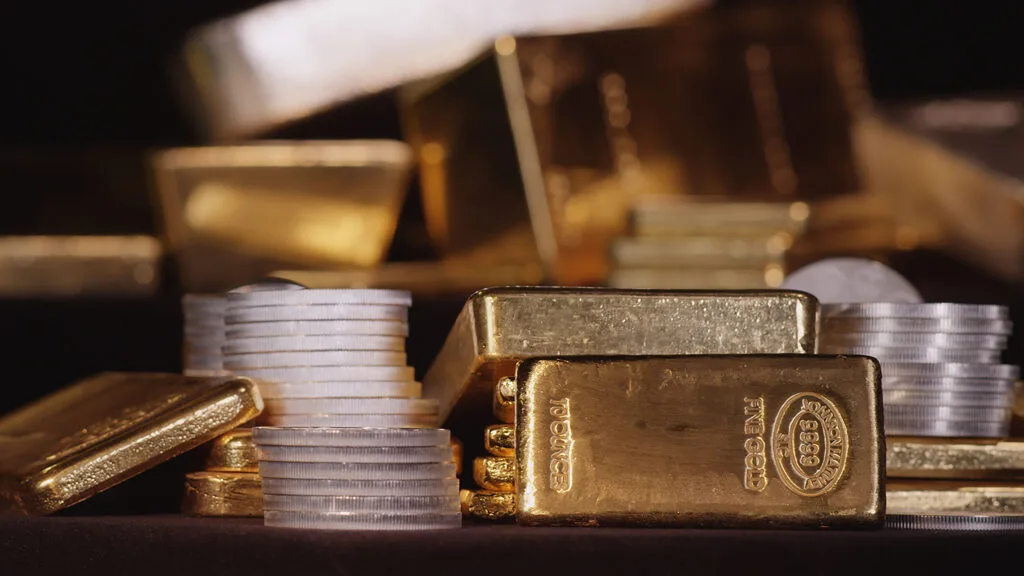
Whether you should invest in gold inside your IRA depends on your risk tolerance, time horizon, and overall portfolio allocation. Here is a clear assessment:
- Gold as a hedge: Gold historically preserves purchasing power during inflation and dollar weakness. During the 2008-2009 financial crisis, gold gained roughly 25% while the S&P 500 lost nearly 50%.
- Gold as a diversifier: Gold has low correlation to stocks and bonds, which means adding it to a portfolio can reduce overall volatility - even if gold itself is volatile.
- Gold limitation: Unlike stocks, gold produces no dividends. Unlike bonds, it pays no interest. Its entire return depends on price appreciation, which is not guaranteed.
- Recommended allocation: Most financial planners who recommend gold suggest limiting it to 5-15% of a retirement portfolio. More than that sacrifices income-producing assets for a non-yielding metal.
Bottom line: Gold in an IRA can be a sensible hedge - but it should complement, not replace, a diversified portfolio of stocks, bonds, and other assets.
How Do I Buy Gold for My IRA? (Step-by-Step)
Here is the exact process for buying gold inside an IRA, from account opening to metal delivery at the depository:
- Choose an IRS-approved SDIRA custodian that specializes in precious metals. Compare setup fees, annual fees, storage options, and BBB ratings.
- Open your self-directed IRA - complete the application online (1-3 business days). Choose traditional (pre-tax) or Roth (after-tax) structure based on your tax situation.
- Fund the account — Execute a trustee-to-trustee transfer from an existing IRA, complete a 401(k) rollover (no contribution cap), or contribute new funds up to $7,000 ($8,000 if age 50+) for 2026. Rollover funds typically clear in 5–10 business days. Note: with an indirect rollover, you have 60 days to complete the transfer or it becomes a taxable distribution subject to income tax plus a 10% early-withdrawal penalty.
- Purchase IRS-approved gold — Work with your dealer to select eligible coins or bars. Your custodian wires IRA funds directly to the dealer on your behalf.
- Secure storage — Your custodian ships the metal directly to an IRS-approved depository such as Delaware Depository, Brinks Global Services, or IDS. You receive a storage confirmation and quarterly statements. You cannot take personal possession while metals remain in the IRA.
Important: You cannot buy gold with personal cash and move it into an IRA. All purchases must be made by the custodian using IRA funds, and metals must go directly to the depository.
Gold IRA Pros and Cons

| Pros | Cons |
|---|---|
|
|
What Gold Can You Buy for an IRA?
The IRS specifies which gold products qualify under IRC Section 408(m). Minimum purity is 99.5% (0.995 fineness), with one exception: American Gold Eagle coins are 91.67% pure but are explicitly approved by statute.
IRA-Eligible Gold Coins
- American Gold Eagle - 91.67% purity (22 karat); explicitly IRS-approved
- American Gold Buffalo - 99.99% purity
- Canadian Gold Maple Leaf - 99.99% purity
- Austrian Philharmonic - 99.99% purity
- Australian Gold Kangaroo - 99.99% purity
- British Gold Britannia - 99.99% purity (2013 and later)
IRA-Eligible Gold Bars
Gold bars must be 99.5%+ purity from a refiner accredited by NYMEX/COMEX, NYSE/Liffe, LME, LBMA Good Delivery List, or a national government mint. Approved refiners include PAMP Suisse, Credit Suisse, Valcambi, Heraeus, and Engelhard. LBMA Good Delivery bars are the global standard for institutional gold trading and are accepted at all IRS-approved depositories.
Bullion vs. proof coins: Bullion coins (like the American Gold Buffalo) carry lower dealer premiums — typically 3–5% over spot price — making them more cost-efficient for IRA investors. Proof coins graded by PCGS/NGC may carry premiums of 20–50% and are generally not recommended for IRA use due to the premium-to-spot ratio.
Not eligible: Numismatic (collectible) coins, jewelry, gold certificates, gold ETF shares (SPDR Gold Shares / GLD), and foreign coins that do not meet fineness standards. Home storage IRA arrangements (sometimes marketed as LLC or "checkbook" IRA structures) are not IRS-compliant — the IRS treats them as distributions, triggering immediate tax plus a 10% penalty.
Gold IRA Costs: Fees, Minimums and Storage
Understanding total costs is critical when buying gold for an IRA. Unlike a standard stock brokerage IRA, a gold IRA involves multiple fee layers:
| Fee Type | Typical Range | Notes |
|---|---|---|
| Account Setup Fee | $50-$150 one-time | Often waived for larger accounts |
| Annual Custodian Fee | $75-$300/year | Flat or scaled to account value |
| Annual Storage Fee | $100-$300/year | Segregated storage costs more |
| Dealer Premium (Coins) | 3-10% over spot | Compare multiple dealers before buying |
| Dealer Premium (Bars) | 1-3% over spot | Lower premium, slightly less liquid |
| Wire / Transaction Fee | $25-$50 per transaction | For buying or selling metals in IRA |
On a $50,000 account, total annual fees (custodian + storage) typically run $200–$600/year, or 0.4–1.2% annually. For smaller accounts, fees as a percentage are higher — this is why most custodians require a $10,000–$50,000 minimum.
Allocated vs. commingled storage: Segregated (allocated) storage means your specific bars or coins are held separately under your name. Commingled (non-allocated) storage pools your metals with other investors' holdings of the same product type. Segregated storage costs $25–$100 more per year but ensures you receive your exact metals back upon distribution. Most investors who buy gold for an IRA should choose segregated storage for maximum accountability.
Spot price and dealer premiums: As of April 2026, spot gold trades near $2,670 per troy ounce. IRA buyers pay spot plus a dealer premium: typically 1–3% for bars and 3–10% for coins. The bid-ask spread when selling is typically 1–2%. Factor total round-trip costs into your break-even calculation.
Buying Gold for IRA at Fidelity vs. Specialist Custodians
Many investors search for buying gold for IRA at Fidelity. Here is the key distinction: Fidelity and Vanguard offer gold exposure through ETFs (like SPDR Gold Shares, ticker GLD) and gold mining funds - but they do not allow you to hold physical gold coins or bars inside an IRA. Physical gold IRA ownership requires a specialist self-directed IRA custodian.
| Feature | Fidelity / Vanguard | Gold IRA Specialist |
|---|---|---|
| Physical gold coins/bars in IRA | No | Yes |
| Gold ETF in IRA (GLD, IAU) | Yes | Varies |
| IRS-approved depository storage | N/A | Required |
| Annual fees | $0-$25 | $200-$600+ |
| Tangible asset (allocated metal) | No (paper claim) | Yes |
To hold physical gold in an IRA, you must open an account with a specialist self-directed IRA custodian — not a traditional brokerage like Fidelity or Vanguard.
Gold IRA Tax Rules, RMDs, and Withdrawals
Gold IRAs follow the same distribution rules as traditional and Roth IRAs. Understanding these rules before you buy gold for an IRA is essential to avoid costly mistakes.
- Required Minimum Distributions (RMDs): Traditional gold IRA holders must begin RMDs at age 73 under SECURE Act 2.0 (passed in 2022). You can satisfy RMDs two ways: (1) sell gold inside the IRA and withdraw cash, or (2) take an in-kind distribution — the depository ships physical coins or bars to you, and the fair market value on that date counts as taxable ordinary income.
- Roth gold IRAs: Roth gold IRAs have no lifetime RMDs. Qualified withdrawals (account held 5+ years, owner age 59½+) are completely tax-free, including any appreciation in gold value.
- Early withdrawals: Withdrawals before age 59½ trigger ordinary income tax on the distribution value plus a 10% early-withdrawal penalty, regardless of gold's market price.
- UBIT (Unrelated Business Income Tax): Standard physical gold in an IRA does not generate UBIT. However, if your SDIRA invests in gold mining partnerships or certain leveraged structures, UBIT may apply. Consult a CPA before using complex SDIRA structures.
- Prohibited transactions: Under IRC §4975, self-dealing is strictly prohibited. You cannot buy gold from yourself, a family member, or a business you control and sell it to your IRA — even at fair market value. Prohibited transactions can disqualify the entire IRA, creating an immediate taxable distribution of the full account balance.
- SEP IRA and SIMPLE IRA eligibility: Self-employed investors can hold physical gold in SEP and SIMPLE IRAs under the same 99.5% purity rules. 2026 contribution limits are higher: $69,000 for SEP IRAs; $16,000 for SIMPLE IRAs ($19,500 if age 50+).
Always consult a qualified CPA or fiduciary advisor for your specific tax situation. Gold IRA tax rules are governed by IRC §408(m), IRS Publication 590-A (contributions), and IRS Publication 590-B (distributions).
What If I Had Invested $10,000 in Gold 20 Years Ago?
Here is the data investors most want to see:
- April 2005: gold traded at approximately $430 per troy ounce.
- April 2026: gold trades at approximately $2,670 per troy ounce.
- A $10,000 investment in April 2005 would have purchased roughly 23.25 ounces.
- Those same 23.25 ounces would be worth approximately $62,100 in April 2026.
- That is a 521% total return, or roughly 9.8% per year annualized.
For comparison, the S&P 500 returned approximately 9.5-10.5% annualized over the same period including dividends. Gold matched equities on a raw return basis - but without dividends and with higher volatility. The lesson: gold can be a meaningful long-term store of value, but it is not a guaranteed outperformer versus equities over every period.
Why Do Warren Buffett and Dave Ramsey Avoid Gold?
Warren Buffett has been one of gold's most prominent critics. His core argument: gold is a non-productive asset. In his 2011 letter to Berkshire Hathaway shareholders, Buffett wrote that all the gold ever mined would form a cube 68 feet on a side — and for that same price, you could buy all US cropland, 16 ExxonMobils, and still have $1 trillion left over. The cropland and companies produce continuous income; the gold cube just sits there.
Buffett's framework is based on compounding productive capital: businesses earn profits, reinvest, and grow. Gold earns nothing. This is a valid objection to gold as a primary investment — but it does not negate gold's role as a defensive hedge in a diversified portfolio. Many investors use gold not as a primary growth engine, but as insurance against systemic financial risk. Even Buffett's Berkshire briefly held shares in Barrick Gold in 2020.
Why Does Dave Ramsey Say Not to Invest in Gold?
Dave Ramsey argues gold is a poor long-term investment for three reasons: (1) it pays no dividend or interest, (2) it has underperformed the S&P 500 over multi-decade periods when dividends are included, and (3) it is frequently marketed using fear-based tactics that inflate its perceived value. Ramsey recommends growth-stock mutual funds for long-term wealth building instead.
Counterpoint: Ramsey evaluates gold as a primary growth vehicle — which it is not designed to be. Most gold IRA investors allocate only 5–15% of their retirement portfolio to gold as a defensive hedge against currency devaluation, systemic banking risk, or geopolitical instability. Used in that role, the Ramsey and Buffett critiques are largely irrelevant. The question is not "gold vs. stocks" but "how much insurance is appropriate for your retirement plan."
A $10,000 gold investment in April 2005 would be worth approximately $62,100 in April 2026 — a 521% total return, or roughly 9.8% annualized. This closely tracked S&P 500 returns over the same period, though gold produced no dividends. If you had invested just $1,000 in gold in April 2016 (approximately $1,230/oz), that $1,000 would be worth approximately $2,170 today — a 117% gain over 10 years, or about 8.0% annualized.
Common Mistakes When Buying Gold for an IRA
- Home storage: Any arrangement claiming you can store IRA gold at home is non-compliant. The IRS requires approved depository storage.
- Ineligible products: Collectible or numismatic coins do not qualify. Verify eligibility before purchasing.
- Ignoring total fees: Some companies advertise low setup fees but charge high dealer premiums or storage fees. Calculate total annual cost as a percentage of your account.
- Overconcentration: Putting 100% of retirement savings in gold eliminates diversification and income potential. Most advisors recommend 5-15%.
- Skipping rollover rules: An indirect rollover must be completed within 60 days or it becomes a taxable distribution with a 10% penalty if under age 59.5.

Top-Rated Gold IRA Company - Free Kit
Augusta Precious Metals is America's most-reviewed Gold IRA company. Get your FREE Gold IRA information kit - no obligation, ships within 24-48 hours.
Request Your Free Gold IRA KitNo obligation. 100% Free. Delivered in 24-48h.